GitHub vs Recto
A detailed comparison to help you choose the right AI tool for your workflow.

GitHub
ArchiQuill is an AI-powered platform that transforms architectural sketches, concepts, and elevation drawings into professional, photorealistic renderings in seconds. Users can convert initial ideas from favorite design software (including SketchUp, Rhino, and Revit) into detailed visualizations for exterior, interior, landscape, and garden designs. It assists designers and architects by offering an AI-driven system to streamline the entire creative workflow. Tools allow for intelligent design suggestions, rapid prototyping, and concept generation, enabling users to quickly move from raw inspiration to fully formed design concepts. The platform distinguishes itself with advanced rendering technology, such as direct Ambient Occlusion (AO) map output, which drastically improves rendering efficiency and visual quality without complex post-processing.
View GitHub →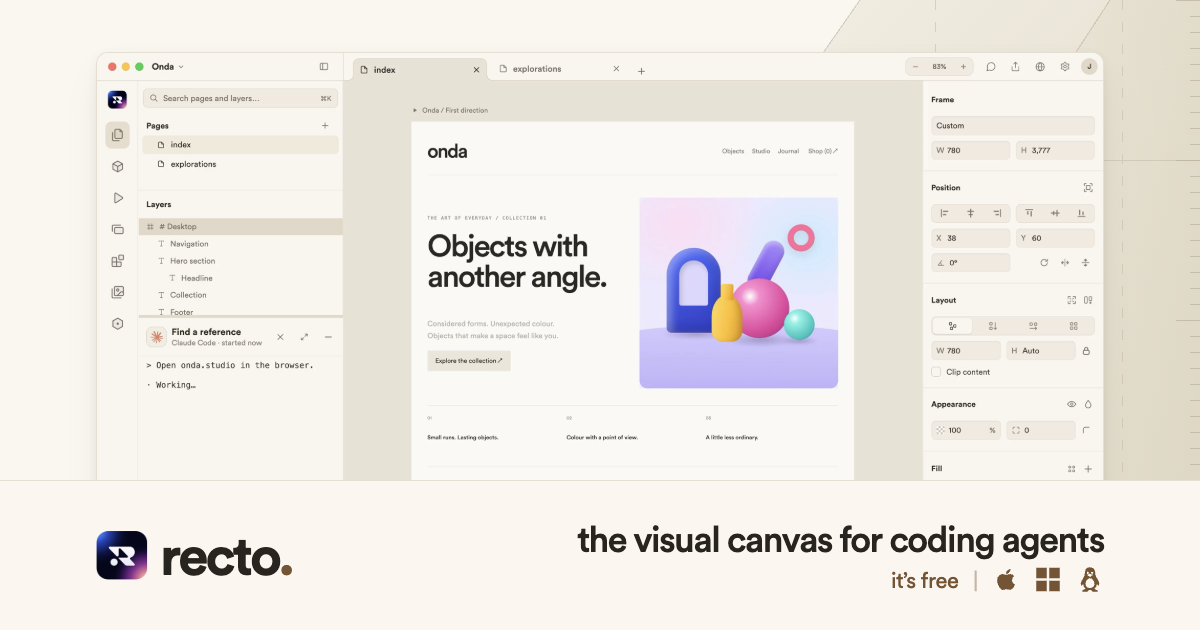
Recto
Recto is a visual canvas designed for coding agents, allowing users to build complex UI, motion, and 3D designs within a single environment. It functions by integrating powerful coding agents—such as Claude Code, Codex, and Cursor—directly into a real-time visual workspace. It is built for developers and designers who rely on AI agents but struggle with the fragmentation of traditional workflows. Recto eliminates the need to switch between terminals, browser previews, screenshots, and prompts, providing a fluid, collaborative design experience. What sets Recto apart is its local, fast operation. It runs directly on your computer, ensuring there are no network round-trips or API configurations required. This local architecture allows agents to work together seamlessly, enabling users to see every change, edit directly on the canvas, or reprompt the system without leaving the tool.
View Recto →Feature Comparison
GitHub
- •Sketch to Render
- •Elevation to Render
- •AI design suggestions
- •Real-time AO Map Rendering
- •Multiple format concept input
Recto
- •Builds UI, motion, and 3D designs
- •Visual canvas for coding agents
- •Works with multiple coding AI agents
- •Runs entirely locally for speed
- •Allows direct canvas editing and reprompting
At a glance
| GitHub | Recto | |
|---|---|---|
| Category | Design & UI | Design & UI |
| Pricing | Freemium | Free |
| Community Rating | No reviews | No reviews |
| Upvotes on Stremit | 70 | 0 |
| Website | archiquill.com ↗ | recto.design ↗ |
GitHub vs Recto: Which is Better?
Choosing between GitHub and Recto depends on your specific needs. Both tools belong to the Design & UI category, making them direct competitors. Compare their pricing, features, and user reviews above to make the best choice for your workflow.
Visit the individual tool pages for more detailed information, community reviews, and feature breakdowns.
Frequently asked questions
What is the difference between GitHub and Recto?
GitHub: ArchiQuill is an AI-powered platform that transforms architectural sketches, concepts, and elevation drawings into professional, photorealistic renderings in seconds. Users can convert initial ideas from favorite design… Recto: Recto is a visual canvas designed for coding agents, allowing users to build complex UI, motion, and 3D designs within a single environment. It functions by integrating powerful coding agents—such as Claude Code, Codex,…
Is GitHub free?
GitHub is listed as Freemium on Stremit. Check the tool's site for current plans.
Is Recto free?
Recto is listed as Free on Stremit. Check the tool's site for current plans.
Are GitHub and Recto competitors?
Yes — both are Design & UI tools on Stremit, so people often compare them before choosing.