MakePixel vs Google Whisk
A detailed comparison to help you choose the right AI tool for your workflow.
MakePixel
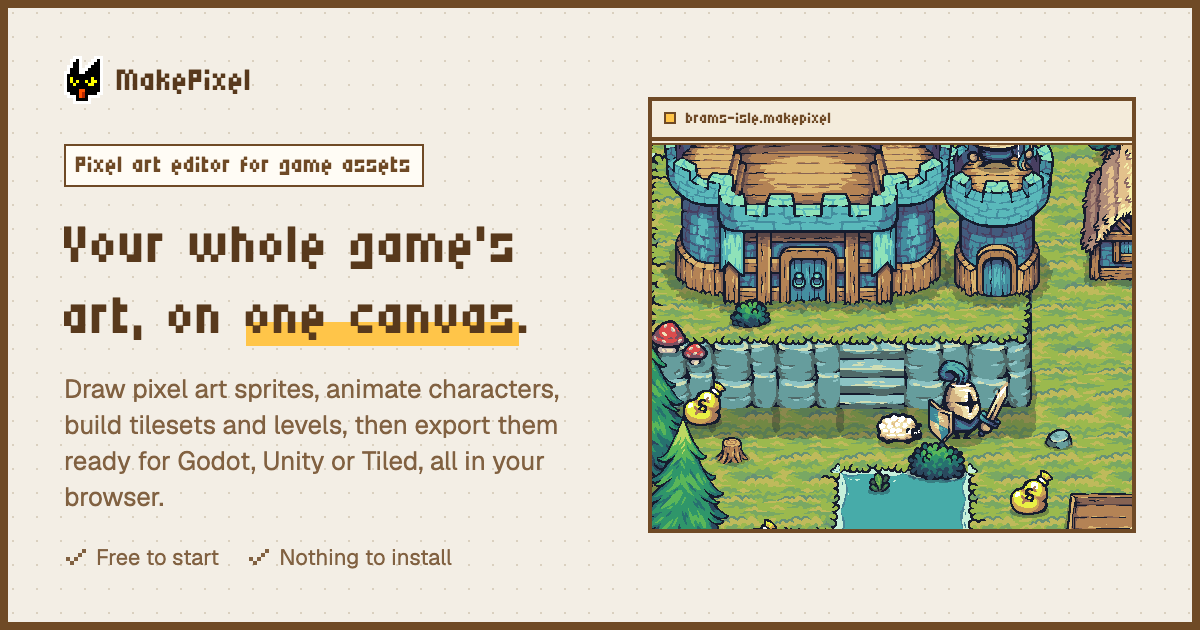
MakePixel is a pixel art editor for game assets that runs in the browser. You draw sprites, animate characters, and build tilesets and levels on one canvas, then export them ready for Godot, Unity, Tiled, or Aseprite. It can also generate pixel art from a text description at 1 credit per picture, and it includes an MCP server that lets coding agents read the canvas and pull sprites into a repository. It is aimed at people making game art who want a whole game's assets in one place. Sections, notes, and an outline keep sprites, animations, and tilesets organised, and a linked asset updates in every project when the original is edited. What sets it apart is autotiling: paint 13 tiles and MakePixel works out the full set of 47. Exports are written in the formats engines read directly, with the filter, pivot, and animation names already set. It is free to start, needs nothing installed, and works on desktop, tablet, and phone.
View MakePixel →
Google Whisk
Whisk is an experimental AI tool designed for creative visualization and image remixing. It allows users to generate images and tell stories by utilizing multiple uploaded images as primary prompts, rather than relying solely on text. Users can drag and drop separate images to define the subject, the scene, and the style for their creation. The tool blends the essence of these input images to generate a unique output, making it a powerful visual concept remixer. This system leverages advanced models, including Imagen 3 for image generation and Gemini for writing detailed captions. While the tool is continuously evolving (with capabilities moving to Google Flow), it remains a resource for creators to explore visual ideas.
View Google Whisk →Feature Comparison
MakePixel
No features listed yet.
Google Whisk
- •Uses multiple images as prompts (subject, scene, style)
- •Generates images using Imagen 3 model
- •Uses Gemini to write detailed captions
- •Blends images by essence, not exact copies
- •Drag-and-drop interface for remixing
At a glance
| MakePixel | Google Whisk | |
|---|---|---|
| Category | Design & UI | Design & UI |
| Pricing | Freemium | Freemium |
| Community Rating | No reviews | No reviews |
| Upvotes on Stremit | 0 | 89 |
| Website | makepixel.ai ↗ | labs.google ↗ |
MakePixel vs Google Whisk: Which is Better?
Choosing between MakePixel and Google Whisk depends on your specific needs. Both tools belong to the Design & UI category, making them direct competitors. Compare their pricing, features, and user reviews above to make the best choice for your workflow.
Visit the individual tool pages for more detailed information, community reviews, and feature breakdowns.
Frequently asked questions
What is the difference between MakePixel and Google Whisk?
MakePixel: MakePixel is a pixel art editor for game assets that runs in the browser. You draw sprites, animate characters, and build tilesets and levels on one canvas, then export them ready for Godot, Unity, Tiled, or Aseprite.… Google Whisk: Whisk is an experimental AI tool designed for creative visualization and image remixing. It allows users to generate images and tell stories by utilizing multiple uploaded images as primary prompts, rather than relying…
Is MakePixel free?
MakePixel is listed as Freemium on Stremit. Check the tool's site for current plans.
Is Google Whisk free?
Google Whisk is listed as Freemium on Stremit. Check the tool's site for current plans.
Are MakePixel and Google Whisk competitors?
Yes — both are Design & UI tools on Stremit, so people often compare them before choosing.