Recto vs Prompt2CAD — From Idea to Parametric CAD with AI
A detailed comparison to help you choose the right AI tool for your workflow.
Recto
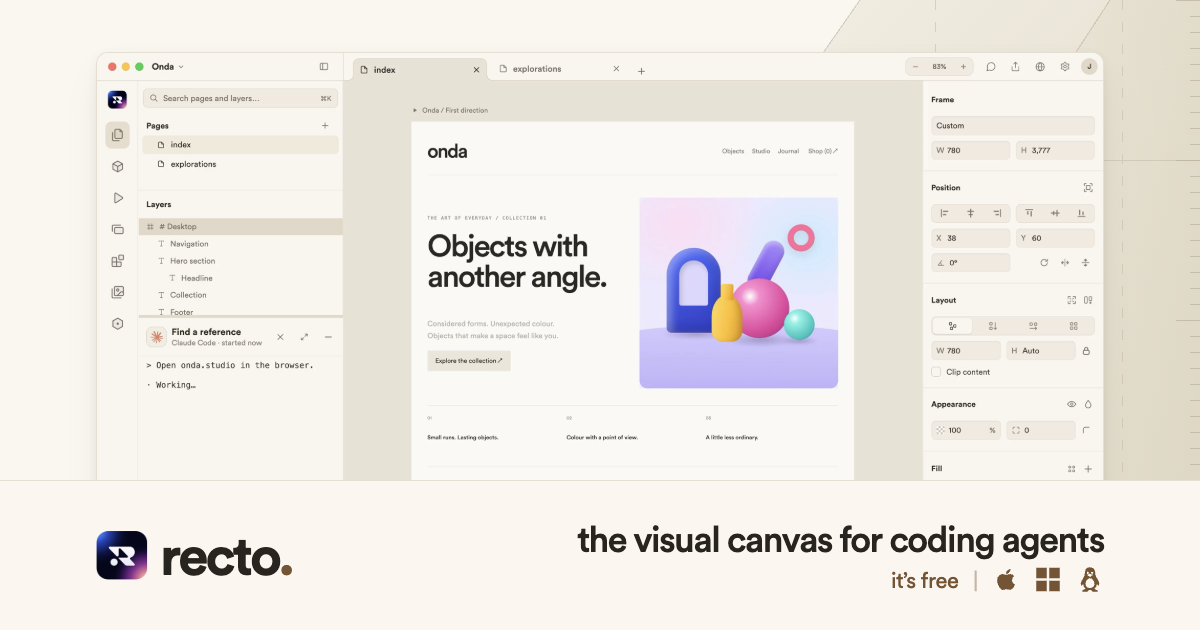
Recto is a visual canvas designed for coding agents, allowing users to build complex UI, motion, and 3D designs within a single environment. It functions by integrating powerful coding agents—such as Claude Code, Codex, and Cursor—directly into a real-time visual workspace. It is built for developers and designers who rely on AI agents but struggle with the fragmentation of traditional workflows. Recto eliminates the need to switch between terminals, browser previews, screenshots, and prompts, providing a fluid, collaborative design experience. What sets Recto apart is its local, fast operation. It runs directly on your computer, ensuring there are no network round-trips or API configurations required. This local architecture allows agents to work together seamlessly, enabling users to see every change, edit directly on the canvas, or reprompt the system without leaving the tool.
View Recto →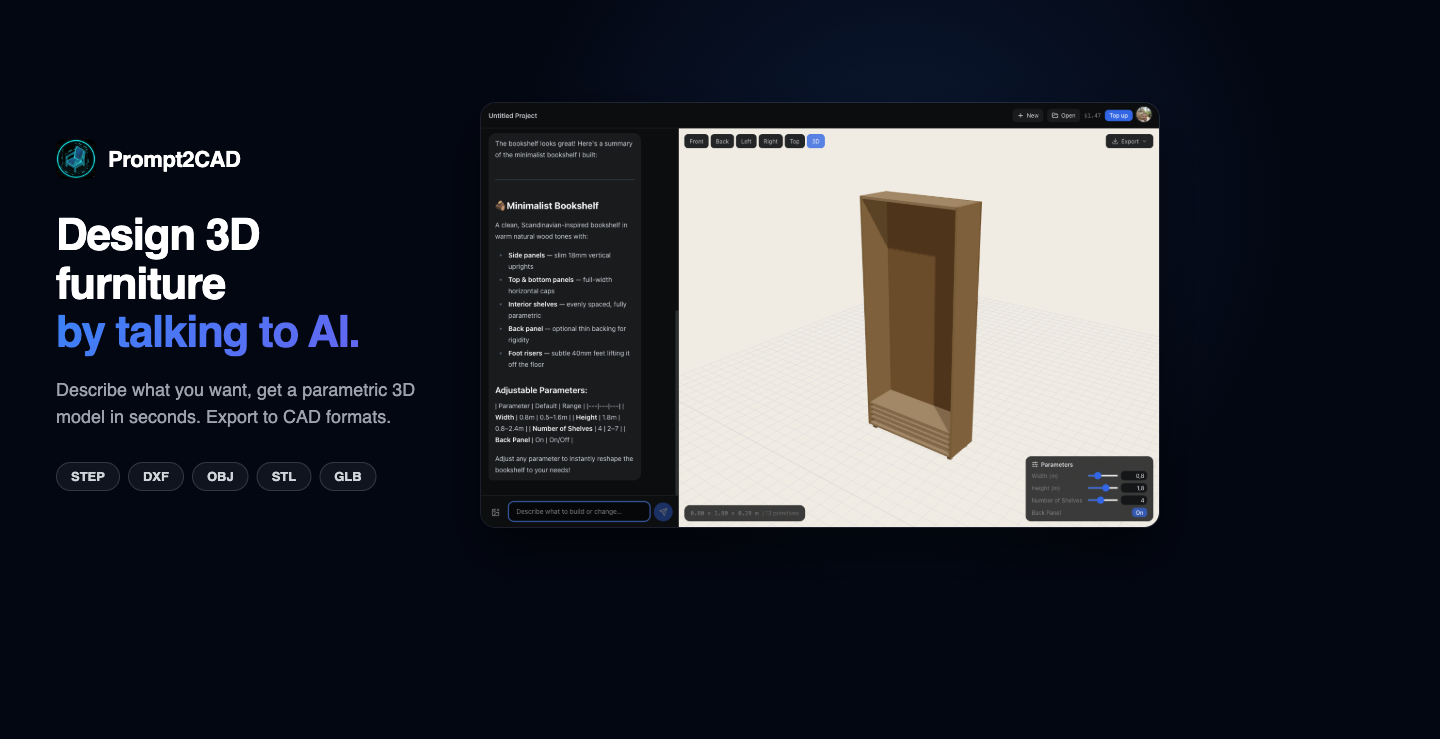
Prompt2CAD — From Idea to Parametric CAD with AI
Prompt2CAD transforms plain language ideas into fully editable, parametric CAD models. It functions as an AI agent that guides the entire modeling process, converting briefs for custom furniture, built-ins, mechanical parts, and products into dimensioned 3D geometry. Users interact conversationally, telling the agent what to build, refining the design by selecting parts or asking for specific changes. The model provides parametric controls—like sliders for width or height—allowing instant adjustments without starting over. It is ideal for designers, engineers, and hobbyists who need real, working CAD files, not simple meshes. Models can be created from text descriptions, uploaded reference images, or existing CAD files (DWG, DXF, OBJ, etc.), and exported to professional formats like STEP, DXF, and STL.
View Prompt2CAD — From Idea to Parametric CAD with AI →Feature Comparison
Recto
- •Builds UI, motion, and 3D designs
- •Visual canvas for coding agents
- •Works with multiple coding AI agents
- •Runs entirely locally for speed
- •Allows direct canvas editing and reprompting
Prompt2CAD — From Idea to Parametric CAD with AI
- •Converts plain language briefs to CAD
- •Supports parametric controls and dimension adjustments
- •Handles complex designs (furniture, mechanical parts)
- •Imports existing CAD/3D models (DXF, OBJ, STL)
- •Outputs editable CAD files (STEP, DXF, 3MF)
At a glance
| Recto | Prompt2CAD — From Idea to Parametric CAD with AI | |
|---|---|---|
| Category | Design & UI | Design & UI |
| Pricing | Free | — |
| Community Rating | No reviews | No reviews |
| Upvotes on Stremit | 0 | 65 |
| Website | recto.design ↗ | prompt2cad.com ↗ |
Recto vs Prompt2CAD — From Idea to Parametric CAD with AI: Which is Better?
Choosing between Recto and Prompt2CAD — From Idea to Parametric CAD with AI depends on your specific needs. Both tools belong to the Design & UI category, making them direct competitors. Compare their pricing, features, and user reviews above to make the best choice for your workflow.
Visit the individual tool pages for more detailed information, community reviews, and feature breakdowns.
Frequently asked questions
What is the difference between Recto and Prompt2CAD — From Idea to Parametric CAD with AI?
Recto: Recto is a visual canvas designed for coding agents, allowing users to build complex UI, motion, and 3D designs within a single environment. It functions by integrating powerful coding agents—such as Claude Code, Codex,… Prompt2CAD — From Idea to Parametric CAD with AI: Prompt2CAD transforms plain language ideas into fully editable, parametric CAD models. It functions as an AI agent that guides the entire modeling process, converting briefs for custom furniture, built-ins, mechanical…
Is Recto free?
Recto is listed as Free on Stremit. Check the tool's site for current plans.
Are Recto and Prompt2CAD — From Idea to Parametric CAD with AI competitors?
Yes — both are Design & UI tools on Stremit, so people often compare them before choosing.