Quash vs. SignalBrain
Ein ausführlicher Vergleich, der dir hilft, das richtige KI-Tool für deinen Workflow zu wählen.
Quash
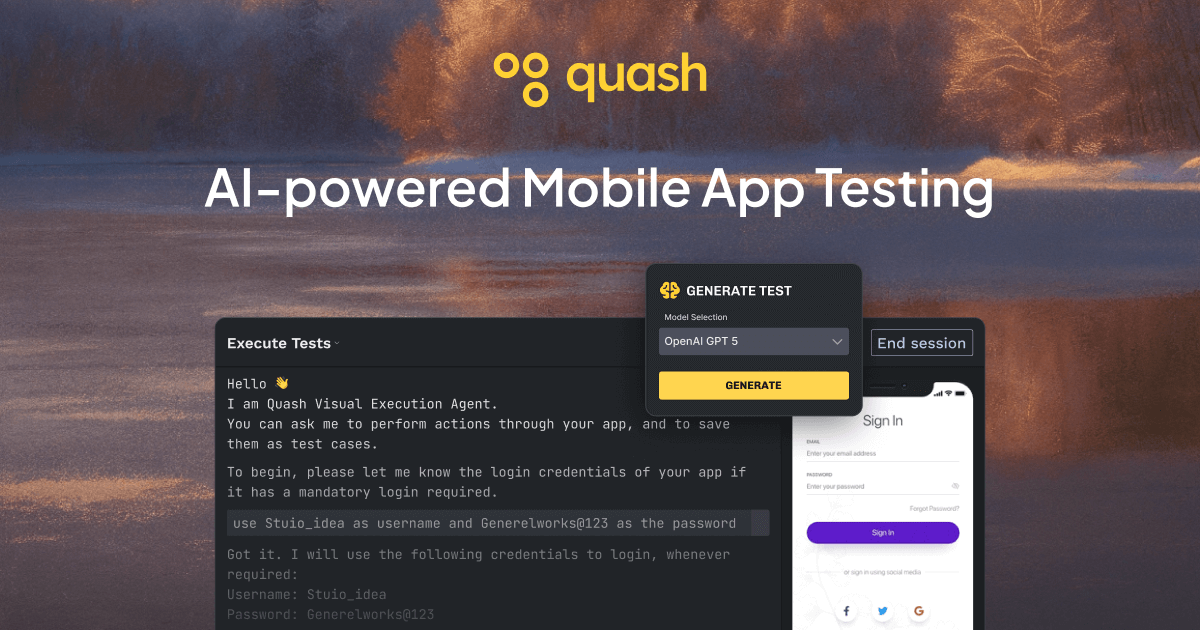
Quash is an AI-powered platform providing mobile, web, and API testing automation for modern development teams. It allows users to generate comprehensive, end-to-end test cases simply by describing expected user behavior in plain language. This intent is then translated into reliable, executable tests that validate everything from UI flows to backend integrations across real devices. It is designed for QA teams and mobile development companies that need to maintain high release velocity and ship with confidence, without the manual drag of traditional QA processes. By moving testing into one single workflow, Quash minimizes brittle scripts and selector maintenance. The platform includes "Mahoraga," an intelligent layer that centralizes the entire testing process—allowing users to create, run, debug, and organize tests all within one conversation. It enhances efficiency by coordinating runs, retries, and complex checks using Runbooks, and connects deeply with existing tools like Jira and Slack.
Quash ansehen →
SignalBrain
SignalBrain provides governed AI infrastructure through the Titan runtime, enabling the deployment of AI models into production. It manages complex, consequential workflows by providing an independent execution boundary that controls the flow from probabilistic intelligence to deterministic action. The system executes a fully traceable, multi-stage request lifecycle: routing, evidence collection, policy enforcement, action, verification, decision, and final receipt. This mechanism ensures every action is governed and accounted for, generating a verifiable record of the entire process. This infrastructure is designed for companies already running AI agents but requiring stringent cost control per answer and enforceable accountability. It allows users to build trust through concrete mechanisms, including deterministic verification and inspectable evidence packets.
SignalBrain ansehen →Funktionsvergleich
Quash
- •Generates tests from plain language product intent
- •Runs tests on real Android, iOS, and browser devices
- •Utilizes Runbooks to coordinate tests and schedules
- •Validates UI behavior and backend APIs simultaneously
- •Centralized workflow via the Mahoraga interface
- •Integrates with tools like Jira, Slack, and Figma
SignalBrain
- •Governed AI routing and authority controls
- •Replayable receipts tracking the entire workflow
- •Deterministic verification using tests and policies
- •Policy-based enforcement for agent actions
- •Evidence collection of artifacts and logs
Auf einen Blick
| Quash | SignalBrain | |
|---|---|---|
| Kategorie | Automation | Automation |
| Preise | — | Contact for Pricing |
| Community-Bewertung | Keine Bewertungen | Keine Bewertungen |
| Upvotes auf Stremit | 89 | 90 |
| Website | quashbugs.com ↗ | signalbrain.ai ↗ |
Quash vs. SignalBrain: Was ist besser?
Ob Quash oder SignalBrain besser passt, hängt von deinen konkreten Anforderungen ab. Beide Tools gehören zur Kategorie Automation und sind damit direkte Konkurrenten. Vergleiche oben Preise, Funktionen und Nutzerbewertungen, um die beste Wahl für deinen Workflow zu treffen.
Auf den einzelnen Tool-Seiten findest du ausführlichere Infos, Community-Bewertungen und Funktionsübersichten.
Häufige Fragen
What is the difference between Quash and SignalBrain?
Quash: Quash is an AI-powered platform providing mobile, web, and API testing automation for modern development teams. It allows users to generate comprehensive, end-to-end test cases simply by describing expected user… SignalBrain: SignalBrain provides governed AI infrastructure through the Titan runtime, enabling the deployment of AI models into production. It manages complex, consequential workflows by providing an independent execution boundary…
Is SignalBrain free?
SignalBrain is listed as Contact for Pricing on Stremit. Check the tool's site for current plans.
Are Quash and SignalBrain competitors?
Yes — both are Automation tools on Stremit, so people often compare them before choosing.