Scroll vs Hebbrix
Une comparaison détaillée pour vous aider à choisir le bon outil IA pour votre workflow.
Scroll
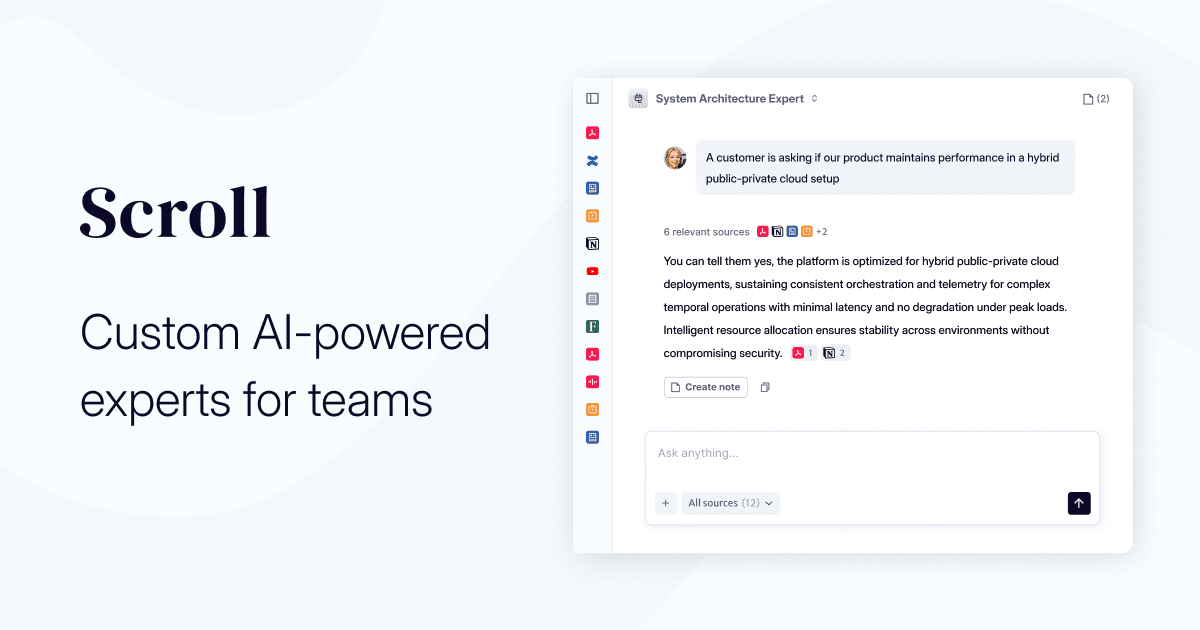
Scroll is a platform designed to quickly deploy specialized AI into mission-critical workflows. It allows users to create highly accurate AI chatbots and intelligent agents that are deeply rooted in a specific knowledge base, ensuring they understand company or project data inside and out. This tool is designed for businesses and teams that need sophisticated conversational AI. Instead of general-purpose chatbots, Scroll provides agents that speak the language of your unique documentation, websites, or proprietary knowledge. Its strength lies in connectivity and deployment flexibility. Created bots can be published directly to a client's website or seamlessly integrated into popular communication tools like Slack and Microsoft Teams, making AI assistance readily accessible where the users already work.
Voir Scroll →
Hebbrix
Hebbrix is a memory layer for AI agents. It retrieves and ranks memory based on what led to good results, not only on what is similar to a query. Agents report outcomes such as success, failure, or corrections against the decision they made, and Hebbrix updates tenant-scoped evidence that shapes later decisions. The product is aimed at teams running AI agents in production who want agents to remember and improve without building memory infrastructure themselves. Integration works by changing the base URL of an existing OpenAI client and passing each end user's id in the standard user field, with no migration or rewrite required. The main difference from similarity search or temporal fact tracking is the outcome question: did acting on this memory actually work. Memory that receives no outcome is not silently deleted, so missing feedback is not treated as failure.
Voir Hebbrix →Comparaison des fonctionnalités
Scroll
- •Knowledge base ingestion
- •Custom agent creation
- •Website publishing
- •Slack integration
- •Microsoft Teams integration
Hebbrix
- •Outcome-weighted recall that ranks memory by measured results
- •Explicit feedback reporting for delayed successes, failures, and corrections
- •Drop-in OpenAI-compatible API by changing the base URL
- •Per-end-user memory via the standard user field
- •Knowledge graph tracking relationships and changed facts over time
- •Memory decay based on usage, recency, importance, and outcomes
En bref
| Scroll | Hebbrix | |
|---|---|---|
| Catégorie | Chatbot & Assistant | Chatbot & Assistant |
| Prix | Paid | Freemium |
| Note de la communauté | Aucun avis | Aucun avis |
| Votes positifs sur Stremit | 86 | 85 |
| Site web | scroll.ai ↗ | hebbrix.com ↗ |
Scroll vs Hebbrix : lequel est le meilleur ?
Choisir entre Scroll et Hebbrix dépend de vos besoins précis. Les deux outils appartiennent à la catégorie Chatbot & Assistant , ce qui en fait des concurrents directs. Comparez leurs prix, fonctionnalités et avis ci-dessus pour faire le meilleur choix pour votre workflow.
Consultez la page de chaque outil pour des informations plus détaillées, les avis de la communauté et le détail des fonctionnalités.
Questions fréquentes
What is the difference between Scroll and Hebbrix?
Scroll: Scroll is a platform designed to quickly deploy specialized AI into mission-critical workflows. It allows users to create highly accurate AI chatbots and intelligent agents that are deeply rooted in a specific knowledge… Hebbrix: Hebbrix is a memory layer for AI agents. It retrieves and ranks memory based on what led to good results, not only on what is similar to a query. Agents report outcomes such as success, failure, or corrections against…
Is Scroll free?
Scroll is listed as Paid on Stremit. Check the tool's site for current plans.
Is Hebbrix free?
Hebbrix is listed as Freemium on Stremit. Check the tool's site for current plans.
Are Scroll and Hebbrix competitors?
Yes — both are Chatbot & Assistant tools on Stremit, so people often compare them before choosing.