Vicoa vs AI Code Reviews
Une comparaison détaillée pour vous aider à choisir le bon outil IA pour votre workflow.
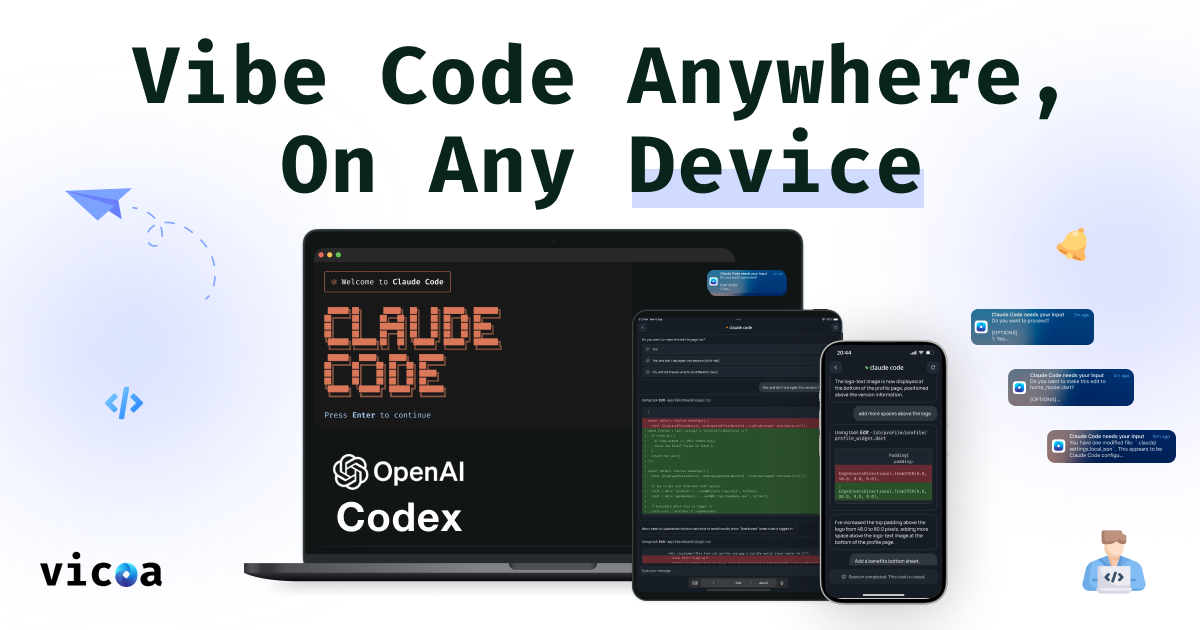
Vicoa
Vicoa is an agent-native IDE for running and managing several AI coding agents at once, including Claude Code, Codex, Gemini, Cursor, and 40+ others. Each agent runs on its own git worktree, and one list shows the live status of every session. It is built for developers who run coding agents across multiple machines. Sessions can be started at a desk, then checked, steered, or approved from a phone, the web, or a laptop. A secure relay connects Mac, Windows, Linux, or remote servers so agents on all of them can be driven through Vicoa. Vicoa keeps each session in sync across phone, web, and desktop, so the same session can be picked up on any device. Code and agents stay on the user's own machines. Changes are reviewed as inline git diffs, alongside a file explorer and a live terminal in the same view.
Voir Vicoa →
AI Code Reviews
CodeRabbit provides independent AI code reviews, acting as a central validation layer for developer workflows. It manages agentic change control by automating PR triage, providing change explanations, and executing continuous security monitoring. It assists teams that need to ship code faster and more reliably, especially when dealing with complex pipelines or automated coding agents. The platform scans for dependency vulnerabilities, reports real-time codebase health, and performs thorough pre-merge and post-merge actions. What sets it apart is its advanced governance for modern development, including industry-leading context and the ability to automate essential tasks like updating changelogs and notifying release channels after a successful merge.
Voir AI Code Reviews →Comparaison des fonctionnalités
Vicoa
- •Run Claude Code, Codex, Gemini, Cursor, and 40+ other coding agents in parallel
- •Each agent runs on its own git worktree
- •Live status list for all sessions
- •Steer and approve agent changes from phone, web, or desktop
- •Secure relay to Mac, Windows, Linux, or remote servers
- •Inline git diff review with file explorer and terminal
AI Code Reviews
- •Automated AI code review and PR triage
- •Continuous security and vulnerability monitoring
- •Pre-merge and post-merge action automation
- •Codebase health scanning and dependency analysis
- •Change explanations and learning generation
En bref
| Vicoa | AI Code Reviews | |
|---|---|---|
| Catégorie | Code & Development | Code & Development |
| Prix | Free | Free Trial |
| Note de la communauté | Aucun avis | Aucun avis |
| Votes positifs sur Stremit | 8 | 88 |
| Site web | vicoa.ai ↗ | coderabbit.ai ↗ |
Vicoa vs AI Code Reviews : lequel est le meilleur ?
Choisir entre Vicoa et AI Code Reviews dépend de vos besoins précis. Les deux outils appartiennent à la catégorie Code & Development , ce qui en fait des concurrents directs. Comparez leurs prix, fonctionnalités et avis ci-dessus pour faire le meilleur choix pour votre workflow.
Consultez la page de chaque outil pour des informations plus détaillées, les avis de la communauté et le détail des fonctionnalités.
Questions fréquentes
What is the difference between Vicoa and AI Code Reviews?
Vicoa: Vicoa is an agent-native IDE for running and managing several AI coding agents at once, including Claude Code, Codex, Gemini, Cursor, and 40+ others. Each agent runs on its own git worktree, and one list shows the live… AI Code Reviews: CodeRabbit provides independent AI code reviews, acting as a central validation layer for developer workflows. It manages agentic change control by automating PR triage, providing change explanations, and executing…
Is Vicoa free?
Vicoa is listed as Free on Stremit. Check the tool's site for current plans.
Is AI Code Reviews free?
AI Code Reviews is listed as Free Trial on Stremit. Check the tool's site for current plans.
Are Vicoa and AI Code Reviews competitors?
Yes — both are Code & Development tools on Stremit, so people often compare them before choosing.